Nonpartisan Education Review / Reviews
Access this review in .pdf format
Access this review in .docx format
Visual Models, Procedural Fluency, and Multiple Strategies:
A Cognitive Critique of
Common Core Elementary Mathematics
by Qianruo Shen
Abstract: This
paper examines the cognitive and curricular problems of Common Core elementary
mathematics. Through analysis of Big Ideas Math and related instructional
practices, it argues that, visual representations are
employed excessively and without sufficient transition to symbolic reasoning
and mathematical abstraction. At the same time, standard algorithms and
procedural memory are de-emphasized, while multiple strategies are treated as
goals in themselves rather than as means to efficient problem solving.
The paper further
argues that the opposition between understanding and memorization reflects a
serious cognitive misconception. In practice, the proliferation of visual
models and solution methods tends to keep instruction at the level of surface
features rather than guiding students toward deeper conceptual structure. As a
result, the curriculum becomes diffuse and overloaded, increasing students’
burden and extending learning time. Difficulties in fractions among American
students reflect these deeper structural and cognitive problems.
The study
concludes that elementary mathematics should remain grounded in practicality,
clarity, and coherent procedural structure so that most students can achieve
solid mastery.
1. Introduction
Over the past half century, the United States
has undergone three major waves of K–12 mathematics reform: the “New Math”
movement of the 1960s and 1970s, the “Reform Math” movement of the 1980s and
1990s, and, since 2010, the Common Core State Standards for Mathematics.[1]
The first two reforms did not achieve their stated goals. The Common Core Standards
have now been in place for more than fifteen years, and their effects have
likewise been widely questioned.
Before Common Core Math was adopted, NAEP
mathematics scores in fourth and eighth grade showed a gradual upward trend
nationwide; while afterward, both have declined.[2] Results from PISA and TIMSS have also
been disappointing.[3][4]
The Common Core Math Standard has sparked
strong backlash in society. Many parents complain that math instruction is
confusing, with homework assignments becoming nonsensical; children learn to
explain concepts but struggle with calculations. Teachers report that the
standards lack practical applicability, classroom rhythms are disrupted, and
students' foundational skills have noticeably declined.
Elementary
mathematics originates in daily life and is meant to serve practical purposes.
Its concepts are concrete, its difficulty moderate. The spread of “math
anxiety” to the elementary level in the United States and Canada therefore
signals not a failure of students or teachers, but of curriculum design. Over the years, some studies have examined the
curriculum and policy dimensions of Common Core.[5][6][7][8] Eric A.
Nelson, meanwhile, offered a cognitive-science critique of the standards,
particularly their treatment of memorization, procedural knowledge, and
automaticity.[9]
“Discovery math” served as a central
instructional approach in the first two reform movements. Liping Ma argued that
its primary weakness lies in its content and structure—namely, a “multi-strand”
organization lacking a clear core.[10] Within this framework,
arithmetic was compressed, while topics such as equations and sequences were
introduced at the elementary level. Moreover, the strands could be changed with
considerable flexibility, resulting in limited coherence and stability.
The Common Core standards have moved away from
the “multi-strand” approach, restoring the traditional content and structure of
elementary mathematics—an improvement that deserves recognition. However, the
influence of discovery math remains significant. Its emphasis on “understanding
over memorization” and the so-called inquiry-based instruction have not only
persisted but have been amplified and systematized, particularly in the
cognitive pathways they promote. This study suggests that such deviations have
contributed to the continuing difficulties in elementary mathematics learning,
rather than leading to the expected improvements.
This
article examines the cognitive flaws of the Common Core Elementary Mathematics
Standards through a close analysis of Big
Ideas Math textbooks.[11] It focuses on arithmetic─numbers, the four operations, and the
development of fluency.
2. Improper and Excessive Use of Visual Representations
In
Big Ideas Math textbooks, many dazzling icons and diagrams immediately catch the eye: grids,
circles or dots, blocks, 10x10 number charts, number lines, arrays, and more.
When handling any concept, they are employed even throughout the entire process.
The extensive use of visual representations is
a long-standing feature of Western mathematics education. When used
appropriately, such tools can make abstract ideas visible, clarify structure,
and help students form mental images. For example, place value is clearly
illustrated with base-10 blocks; the number line is essential for introducing
zero and negative numbers; and the understanding of fractions and percentages
benefits from grids and circles, where part–whole relationships are not easily
grasped through symbols alone.
Effective use of visual
representations depends on precise verbal explanation and symbolic operations
to clarify underlying structure and logic. However, Big Ideas Math places
excessive reliance on diagrams while neglecting these supports; as a result, even
accurate visuals often fail to achieve their intended effect.
When
overused or misapplied, visual methods become even counterproductive.
Unfortunately, both discovery-based mathematics and Common Core curricula
frequently fall into this latter category.
The
following are typical situations of misuse of visual models in Common Core
elementary mathematics.
l Using visual tools for calculation. Visual representations are intended to support
conceptual understanding, not to serve as tools for computation─which is often
inefficient, cumbersome, and imprecise—yet such practices have become
widespread.
A
particularly problematic example is the use of a 10×10 number chart for
addition and subtraction through counting on or back—a method no more efficient
than simple counting on fingers. Similarly, the use of the number line for
addition, subtraction—especially with large numbers—poses practical
difficulties, as students cannot locate results with sufficient precision.
The use of arrays to perform multiplication is
impractical too. Such tasks can be handled far more efficiently through mastery
of the multiplication table.
l The mismatch between tools and objects. In some cases, the visual model does not match
the structure of the concept it is meant to illustrate.
Number line is used everywhere, but some of its
applications are improper. Number line effectively represents addition─moving
to the right, and subtraction─moving to the left. However, multiplication is
not about directional movement but about structural scaling. The number line
fails to capture this essence, applying it in this context reflects a mismatch
between tool and object, making a
second-order operation remain at the first-order level.
l Replacement of real-life examples by visual
models
Topics
of elementary mathematics are closely related to everyday life. When
introducing new concepts, instruction should ideally begin with familiar,
real-life examples that engage students and stimulate curiosity. However, Big
Ideas Math often introduces concepts through visual diagrams, while everyday
contexts are underused or deferred.
For
example, multiplication and division can be introduced through simple, concrete
situations: “A box holds 12 eggs; how many eggs are in 4 boxes?” or “40
students are divided into 5 groups; how many are in each group?” Such intuitive and meaningful questions can
strongly stimulate students’ thinking, yet they are rarely seen in the
textbooks. Fractions, too, are commonly introduced through
circles, grids, and number lines, with limited connection to practical
contexts. Another example, the
distributive property can be illustrated through everyday situations, such as
calculating the cost of a shared meal, yet textbooks begin with grid diagrams.
As
a result, the visual models often displace the natural starting point of
learning—from concrete experience—and weakens the development of conceptual understanding at its earliest
stage.
l Continual use of visual models hinders
abstraction. Visual models are used throughout the learning process,
often extending to stages where they are no longer appropriate.
Base-10
blocks, for example, provide a clear representation of place value in early
stages. However, when decimals are introduced, continued reliance on these
models are both confusing and unnecessary: since such diagrams become
increasingly complex and difficult to interpret, meanwhile students have
internalized the underlying concept.
Visual
representations accompany all four basic operations─addition, subtraction, multiplication and
division─often to the end of the process, while symbolic
computation is relatively marginalized.
Yet visual models are
not the endpoints of learning. Their purpose is to support understanding and
guide students toward abstract thinking—not to replace it. Therefore, visual
representations should be used with restraint and should give
way, in a timely manner, to abstract mathematics. Sustained dependence on
visual aids keep students
at a low, concrete, and immature level of thinking, ultimately impeding rather
than advancing cognitive development.
To summarize, there is
broad agreement on the proper role of visual models, across the history of
mathematics, findings in cognitive science, and classroom practice. Visual
representations are not central; they are to illustrate underlying structures
at appropriate stages, not to dominate the learning process. The repeated,
indiscriminate, and prolonged use of visual models has become a significant
weakness. It reflects a misunderstanding of the nature of mathematics.
3. Devaluation and Weakening of Procedural Rules and Fluency
When
visual models are treated as the primary path to understanding,
well-established procedural knowledge and skills are regarded as rigid routines
that students can’t understand, thus are devalued and weakened.
American
students’ limited mastery of standard column algorithms for the four basic
operations provides a clear example of this marginalization.
Long proven to be both reliable and
efficient, standard algorithms remain the most powerful tools for numerical
computation in elementary mathematics. Their effectiveness rests on the base-10
place-value system and the distributive property: numbers are decomposed into
place-value units (ones, tens, hundreds), operated on, and then recombined
through systematic carrying and borrowing. In this way, calculations become
structured, transparent, and repeatable.
These methods are not inherently difficult.
With clear explanation and carefully sequenced examples, students can develop
both understanding and mastery. Yet in practice, common errors—such as
misalignment of place value or incorrect subtraction procedures—appear
frequently in classroom work and assessments.
Such
difficulties are often attributed to a “lack of conceptual understanding” or to
excessive reliance on rote memorization. In reality, however,
the problem often lies in the opposite direction: while visual models occupy
substantial instructional space, the establishment of procedural principles is not
clear and firm enough, and their practice is far less than needed.
The
traditional progression of procedural learning is well established: from
principle, to rule formulation, to memorization, to practice, to fluency, and
ultimately to automaticity. Once the underlying principles are understood, the
crucial step is to establish clear operational rules and reinforce them through
practice.
As Eric A. Nelson[9] and Stanford
mathematicians R. James Milgram and Ze’ev Wurman[12] have noted, the
Common Core standards place insufficient emphasis on automaticity and
procedural fluency—foundational elements of mathematical achievement in
high-performing systems. Without it, even “understanding” remains
slow, effortful, and unreliable.
When
basic rules are not firmly established and practiced, the progression from
understanding to fluency and automaticity cannot be completed. This weakness at
the foundation of arithmetic makes further development of mathematical
competence increasingly difficult.
4. Goal Drift: Overemphasis on Multiple Strategies
In
Common Core mathematics, multiple strategies are often treated as a hallmark of
“understanding,” leading elementary mathematics to drift away from its core
objectives.
To
cross a river, one might wade, swim, take a boat, or build a bridge. As long as the other bank is reached, the goal has been
achieved. No one would repeat every
possible approach. Big Ideas Math, however,
systematically presents all strategies for every problem, and expects students
to learn each one.
While
it is valuable for a problem to admit more than one solution, multiple
strategies are neither the goal nor a necessity. The primary purpose of
mathematics is effective problem solving. Students need to recognize which
methods are more fundamental, efficient, and broadly applicable. Precision and
economy constitute the true elegance of mathematics.
For example, in addition and subtraction within
100, alongside number charts and number lines, students are introduced to a
wide range of named strategies—such as partial sums, regrouping, using
doubles, compensation, and
others. While some of these may serve as useful mental shortcuts, they do not
all require formal and systematic instruction. Not to mention some
methods such as “using doubles” are basically useless.
In
contrast, with a good number sense of “making a ten”, the standard column
algorithm can solve the problems efficiently.
A
similar issue appears in two-digit by two-digit multiplication. Again Big Ideas Math
presents a long list of methods:
place-value (tens×tens+tens×ones+ones×tens+ones×ones);
area models (total area=sum of areas of the 4 small rectangles); distributive
property (for example, 14×23=(10+4)×(20+3)=10×20+10×3+4×20+4×3); and
partial products, regrouping, etc.
Yet
these are not fundamentally different methods; but variations built on the same
underlying structure. Treating them as separate strategies can turn a
straightforward task into an unnecessarily complex and time-consuming task. As
instructional time is spread across multiple strategies, practice of the
standard algorithm is reduced, making it difficult for students to achieve
fluency and automaticity.
Fragmented
techniques are often presented as “innovations” to demonstrate diversity of
methods. This proliferation without clear priority leaves the curriculum
diffuse and unfocused, and may hinder rather than
deepen understanding.
5. Memorization,
Understanding, and Structure
“Understanding”
has become a central slogan in Common Core mathematics. The instructional
practices discussed above—heavy reliance on visual models, the de-emphasis of
procedural rules, and the promotion of multiple strategies—are all intended to
serve this goal.
A
widely observed pattern in American K–12 mathematics is that,
students’ difficulties become most apparent from the upper elementary to middle
school years. Earlier content often involves basic numerical ideas that
students can grasp through everyday experience. However, when instruction
reaches topics requiring systematic learning—such as fractions and their
operations—many students encounter significant difficulties.
These
difficulties are often attributed to a “lack of comprehension” or to “rote
memorization.” In practice, however, American students typically memorize
neither multiplication tables nor basic formulas, which are often provided
during examinations. In this sense, memorization is used far less than
children’s learning capacity would allow.
Framing
understanding and memorization as opposites—praising the former while
dismissing the latter—reflects a misconception. In reality, they
are interdependent: understanding supports memory, and memory provides the
basis for deeper understanding. Without memorization and practice, the so-called
“understanding” is often vague and unstable.
The
pattern of memorizing first and
understanding later is not uncommon, especially for children.
When complete conceptual clarity is not immediately attainable, rules still
need to be learned and practiced, otherwise, students risk staying in a state of partial understanding and
stagnation.
Mathematics is
fundamentally concerned with concepts, structures, and relationships, and
instruction ultimately aims at conceptual clarity and the development of
abstract thinking. Learning should proceed from phenomena to underlying
structure—that is, from the concrete to the abstract, and from surface features
to deeper logic.
Genuine conceptual structures are typically
simple and unified; deep understanding is reflected in clarity and economy. However a proliferation of diagrams and methods tend to keep
learning at the level of surface features[13], rather than guiding
students toward underlying structure. As a result, the curriculum becomes
diffuse and overloaded —fragmented, drifting, and lacking clear direction—while
also increasing students’ burden and extending learning time.
This helps explain why many American students
struggle to develop mathematical abstraction at an appropriate stage.
6. Why Fractions Become a Barrier for American Students
An area of weakness for American students lies
in fractions and their operations─TIMSS and PISA have repeatedly highlighted
this problem─their learning process and outcomes clearly reflect the
cognitive issues discussed above.
In
Big Ideas Math, visual models—rectangles, circles, and number lines—are used
extensively, and basic fraction concepts occupy a substantial portion of
instructional time. Remarkably, the textbook devotes about 60 pages to addition
and subtraction with like denominators—a relatively straightforward topic.
By
contrast, operations with unlike denominators—which represent both a central
objective and a major source of difficulty—receive comparatively limited and
fragmented treatment. The common-denominator method, a standard and efficient
approach, is often presented as only one option among multiple strategies
rather than as a core procedure to be mastered.
Fraction multiplication and division likewise
generate a wide range of errors: multiplying a whole
number to a fraction by timing it with both the numerator and the denominator;
using cross-multiplication in place of multiplying numerators and denominators
separately; and in division, inverting the dividend rather than the divisor.
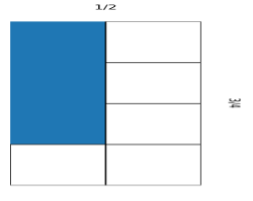
The figure represents an area model for (1/2)×(3/4)=(1×3)/(2×4), the shaded area includes 1 × 3 small rectangles, whereas the whole figure contains 2 × 4; hence the product is 3/8.
Textbooks
employ both tape diagrams (one-dimensional) and area models (two-dimensional)
to represent fraction multiplication. While the area model is generally more
appropriate, it is often tied to specific examples and lacks clear
generalization. It does not adequately explain why numerators and denominators should
be multiplied separately, or why dividing by a fraction is equivalent to
multiplying by its reciprocal.
Moreover,
when finding common denominators, textbooks often use the product of
denominators rather than the least common multiple. In multiplication and
division, students are not required to simplify fractions during intermediate
steps. Systematic instruction in fraction reduction is often delayed, leaving
gaps in students’ procedural fluency.
American
students are generally able to recognize fractions in visual models and handle
simple comparisons. However, when the operations require rule-based procedure
without visual support, performance declines sharply, since students do not
know how to proceed.
A
2022 study illustrates this problem.[14] Students were asked to
compare 2/3, 3/4, and 3/8. Researchers identified as many as 12 different
strategies, including visual, symbolic, and verbal approaches. Among 214
students, roughly one quarter gave no answer, and nearly half relied on visual
methods—yet only 28% reached the correct conclusion. By contrast, about 2/3 of
those using a common-denominator method answered correctly.
The key issue is not simply variation in
performance across strategies. Rather, the study interprets the solution as
encouraging students to learn multiple approaches, without addressing the
limitations of certain methods. In doing so, it risks reinforcing the very
confusion that the results reveal, rather than strengthening core procedural mastery.
7. Concluding
Reflections
Elementary mathematics
serves all children. Its primary task is to equip students with essential
skills for life—an aim that curriculum standards and textbooks must
consistently uphold. Interest and practicality are central and mutually
reinforcing; when properly maintained, they enable most students to achieve
solid mastery. Conceptual understanding and thinking abilities emerge naturally
from this process; when mathematics is detached from practical experience,
abstraction loses its grounding.
Within
K–12 education, elementary mathematics has been especially susceptible to
reform and extensive redesign. Yet as the foundation of both mathematics and
science learning, its weakening carries long-term consequences. Insufficient
fluency and unstable conceptual structure at this stage translate into later
difficulties in algebra, trigonometry, geometry, and the sciences. Over time,
repeated struggle shapes’ confidence and contribute to the perception of STEM
fields as difficult and inaccessible.
The United States has
long been a leader in innovation. Yet education is not primarily an arena for
rapid innovation, but a social function grounded in the transmission of
knowledge; changes within it therefore require clear limits and careful
validation. Reforms that alter foundational knowledge structures and cognitive
pathways demand particular caution—an essential
principle that has been overlooked in contemporary educational discourse.
As Frederick M. Hess
has observed,[5] the Common Core was implemented on a nationwide
scale with limited prior testing or built-in safeguards. The costs of such
large-scale reforms extend beyond ineffective outcomes, affecting the cognitive
development of an entire generation, and the scientific and economic competence
of the nation.
Restoring stability and
quality in education depends on reaffirming this principle and pursuing steady,
carefully considered improvements over time.
May
2026
References
[1]
National Governors Association Center for Best Practices and Council of Chief
State School Officers. Common Core State
Standards for Mathematics. Washington, DC, 2010.
[2]
Pioneer Institute. “Study Finds Historic Drop in National Reading and Math
Scores Since Adoption of Common Core Curriculum Standards.” April 27, 2020.
[3]
Mullis, Ina V. S., Michael O. Martin, Pierre Foy, et al. TIMSS 2019 International Results in Mathematics.
Boston: TIMSS & PIRLS International Study Center, 2020.
[4]
Organisation for Economic Co-operation and Development (OECD). PISA 2022 Results (Volume I): The State of Learning
and Equity in Education. Paris: OECD Publishing, 2023.
[5]
Hess, Frederick M. “How the Common Core Went Wrong.” National Affairs, no. 65 (Fall 2025).
[6]
Polikoff, Matthew S., Michael J. Petrilli, and Tom Loveless. “A Decade On: Has
Common Core Failed?” Education Next
20, no. 2 (2020): 72–81.
[7]
McArdle, Elaine. “What Happened to the Common Core?” Harvard Graduate School of Education.
September 2014.
[8]
Lianxi, “The Century-Long Math Wars in the United States”,
Pipixia WeChat Official Account, 2017 (in Chinese).
[9] Nelson, Eric A. "Cognitive Science and the
Common Core Mathematics Standards.” "Nonpartisan
Education Review 13, no. 3 (2017): 1–19.
[10]
Ma, Liping. “A Critique of the Structure of U.S. Elementary School
Mathematics.” Notices of the American
Mathematical Society 60, no. 8 (2013): 1282–1296.
[11]
Larson, Ron, and Laurie Boswell. Big Ideas
Math: Student Edition (Common Core 2019). Erie, PA: Big Ideas
Learning, 2019.
[12]
Milgram, R. James, and Ze’ev Wurman. The
Mathematics Standards in the Common Core State Standards Initiative.
Stanford University, 2014.
[13]
Shen, Qianruo. “The Discovery-Based Curriculum
Undermining Elementary Mathematics.” Bulletin
des Sciences Mathematics 56, no. 11 (2017): 7–11. (in Chinese)
[14]
Liu, J., and E. Jacobson. “Examining U.S. Elementary Students’ Strategies for
Comparing Fractions After the Adoption of the Common Core State Standards for
Mathematics.” 2021.
About the Author
Dr. Qianruo Shen is an independent scholar and Honorary
President of the Educational Quest Society of Canada. Her work focuses on
comparative education, with particular interests in
education systems, educational policy, and the teaching of science and
mathematics. She graduated from the Physics Department of Peking University, received
her M.Eng. from Beijing University of Aeronautics and Astronautics, and her
Ph.D. in Applied Mathematics from Simon Fraser University.
Email: sharon_q_shen@yahoo.com.
Access this review in .pdf format.
Citation: Shen, Q. (2026). Visual Models, Procedural Fluency, and Multiple Strategies: A Cognitive Critique of Common Core Elementary Mathematics," Nonpartisan Education Review / Reviews / Vol.22, No.1. Retrieved [date] from https://nonpartisaneducation.org/Review/Reviews/v22n1.pdf
.